Monday, June 13, 2016

Aerial tree seeding in East Africa - Some of the first things to consider.


Aerial reforestation is not a full replacement for planting seedlings by traditional methods. 


It is best considered as a potential complement to conventional planting and to natural seeding, an additional tool for foresters to use when the needs, sites, and species are appropriate. 


Sowing tree seeds directly in the field is an old technique but it was little used until the development of repellents to protect seed from insects, rodents, and birds. 
Today aerial seeding is already regarded as a practical reforestation technique in a few countries. There it is fully operational. More than a million hectares of well-stocked forests in the United States, Canada, Australia, and New Zealand demonstrate its success. Some of these forests have been established despite seemingly adverse conditions-for example, on steep slopes and on overburden from strip mines. 
Although aerial seeding technology has been used mainly in industrialized countries in temperate areas, it would seem the techniques could be modified for use elsewhere. Whether it will prove widely applicable in the arid tropics is still unknown. The uncertainties regarding its application in new regions lie mostly in whether the native animals and plants, as well as local climatic conditions, will permit its success. Nonetheless, sufficient knowledge has been accumulated in large-scale operations in North America and Australasia to justify wide-ranging trials in developing countries.

Currently in India Aerial seeding has been taking place to the tune of 1000's of tons of seeds being dispersed in conjunction with Navy helicopters.  http://www.thehansindia.com/posts/index/Andhra-Pradesh/2016-06-11/Vizag-regains-lost-greenery/234270 and also http://www.newindianexpress.com/states/andhra_pradesh/Aerial-Seeding-Operation-Comes-to-Vizag-Navy-to-Help/2015/08/31/article3002402.ece
When sites and species are right, aerial seeding can be as successful as the more conventional process of planting seedlings. For example, pine forests have been well established in over 90 percent of the attempts in the southern United States.

Direct Seeding


Aerial seeding is just one example of the more general process of broadcast seeding by which the seed may also be sown from the ground using mechanical spreaders or by hand. Ground-seeding methods will be preferable to aerial seeding in many situations in developing countries. In such cases, the principles and requirements are similar to those discussed here.

The advantage of the airplane is its ability to quickly seed large areas, even remote areas, when conditions for prompt germination and survival are best.


Aerial Seeding Sites
Aerial seeding is best suited to sites whose remoteness, ruggedness, inaccessibility, or sparse population make seedling planting difficult. It is particularly appropriate for "protection forests" because helicopters or planes can easily spread seed over steep slopes or remote watersheds and isolated upland areas. It seems well suited for use in areas where there may be a dearth of skilled laborers, supervisors, and funds for reforestation (Large tracts can be seeded so rapidly that supervising personnel are freed for other duties in a relatively short time. A ground crew of only three flagmen and two men to weigh and load seed are usually required). It has the potential to help increase production of tree crops for forage, food, and honey as well as wood for fuel, posts, lumber, and pulp. 
A deforested water catchment area on the South Mau Forest.


Aerial seeding can often be quickly deployed because there is no wait for seedlings to grow in a nursery (which may take 3 months to 3 years). It may be used on areas denuded by clear cutting or shifting cultivation. Also, sites of catastrophes such as forest fires, hurricanes, insect devastation, battles, volcanic eruption, or landslides can be promptly reseeded with useful tree species if seed is available (sometimes a deliberate burn or other technique may be needed to remove weeds and complete preparation of the seedbed). 
logging slash on Mt Kenya. 

For example, if a wildfire bares the soil on a remote watershed and makes it vulnerable to erosion, aerial seeding can be used on the ash-strewn seedbed before weedy species overrun the site. In some cases, a mixture of seed can be applied so that herbaceous plants such as mustard, grasses, or herbaceous legumes provide a quick ground cover that protects and "nurses" the young tree seedlings and suppresses undesirable weeds.

On the other hand, rapid deployment may not be practical in some cases because the site may require preparation or the season may be wrong.
To germinate successfully, seeds usually must fall directly onto mineral soil rather than onto established vegetation or undecomposed organic matter. Where organic matter has accumulated thickly, the site must normally be burned, furrowed, or disked. The soil disturbance left after logging is often sufficient. 

Rough terrain is especially amenable to broadcast seeding.


On certain sites ground preparation may be necessary. Site preparation and the seeding operation must be well coordinated to meet the biological requirements for prompt seed germination and seeding survival. Dry sites may have to be specially ridged or disked so as to optimize the rainfall that reaches the seed. Excessively wet sites may need to be ridged or drained.
The degree of slope is not critical as long as seeds find a receptive seedbed. Steep watersheds, eroding mountain slopes, bare hillsides, and spoil-banks where vegetation is sparse are often suitable for aerial seeding (however, on some steep slopes with smooth, bare soil, rain may wash the seeds away too easily for successful seeding). On steep strip-mine spoils in West Virginia and in Indonesia slopes of more than 30° (about 70 percent slope) have been successfully revegetated from the air.
Arid and savanna lands (for example, those where annual rainfall is under 500 mm) are most in need of reforestation. These are regions where aerial seeding in principle has exceptional potential. They include vast tracts of unused or poorly used land that has sparse tree cover and that is not confined to private land holdings, so it is generally accessible to aircraft. The native trees (such as species of Acacia, and other genera) in these areas are generally well adapted for survival under difficult field conditions. These are not species for timber as much as for firewood, forage, fruit, gum, erosion control, and other such uses. On dry sites, the amount of successful establishment is increased if the seed can be covered with a thin soil layer.

erosion narok
A potential ex-wheat farming site near Narok in dire need of rehabilitation. 
Species
As a prerequisite to any method of reforestation, the species selected must be adapted to the temperature, length of growing season, rainfall, humidity, photoperiod, and other environmental features of the area. Ideally, before aerial seeding takes place trial plots should be established to test those species most likely to germinate and grow successfully on the chosen sites. Even when one species has the right characteristics, it may be prudent to test seed of different provenances to find those best suited to the site.
Aerial seeding has been used mostly with conifers and eucalypts, although other species that reseed themselves successfully in a given region could also be aerially seeded with reasonable probability of success. However, in nature seed germinates over a relatively long period, and though environmental factors may be hostile at one time, they usually prove favorable at another. With broadcast seeding, only one or two applications are made, the seeds germinate together, and if timing is off, the results will be poor.


Characteristics that make a particular species appropriate for aerial seeding include:
. Small or medium-sized seed,
· Frequent and prolific seed availability;
· Ability of the seed to germinate on the soil surface;
· Fast germination and rapid seedling growth,
· Ability to withstand temperature extremes and prolonged dry periods,
· Ability to tolerate a wide range of soil conditions;
· High light tolerance;
· Seed that is easy to collect in large quantities and to store for long periods;
· Suitability of seed for handling with mechanical seeding devices; and
· Rapid development of a deep taproot by seedlings to enable them to withstand adverse
climatic conditions in the period following germination.


Species with highly palatable seeds have little prospect of success because wildlife eat the seed before it has a chance to germinate unless it is pelletized. Also, small seeds and lightweight, chaffy seeds are more likely to drift in the wind, so they are harder to target during the drop. (This can be compensated for by adding a thick coating to the seed.) Small seeds, however, fall into crevices and are then more likely to get covered with soil, thereby enhancing their chances of survival.
Aerial seeding may prove to work best with "pioneer" species, which germinate rapidly on open sites, are adapted for growth on bare or disturbed areas, and grow well in direct sunlight


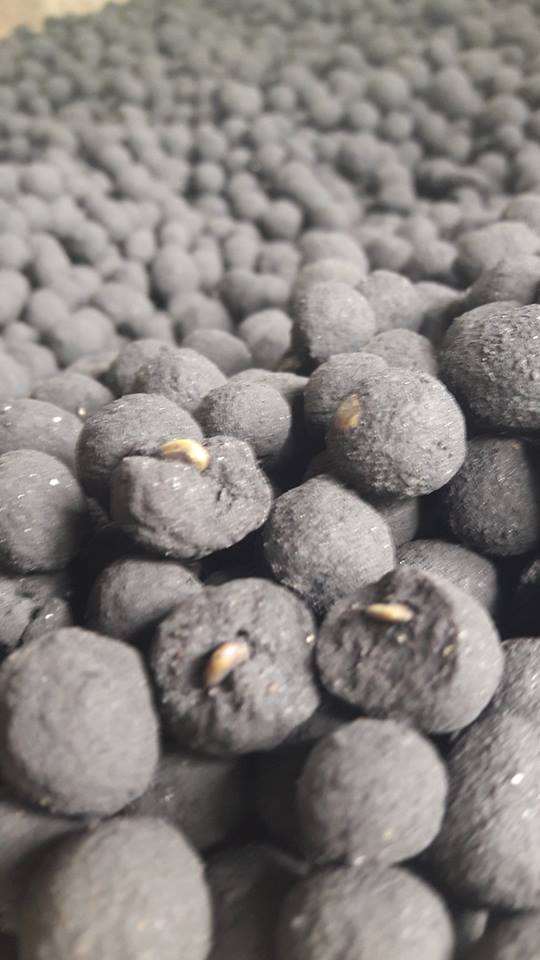
An indigenous acacia xanthophloea seedling that has germinated from a biochar seedball. Please learn more about how it protects itself from browsers here Why is the African Savanna so full of thorns?


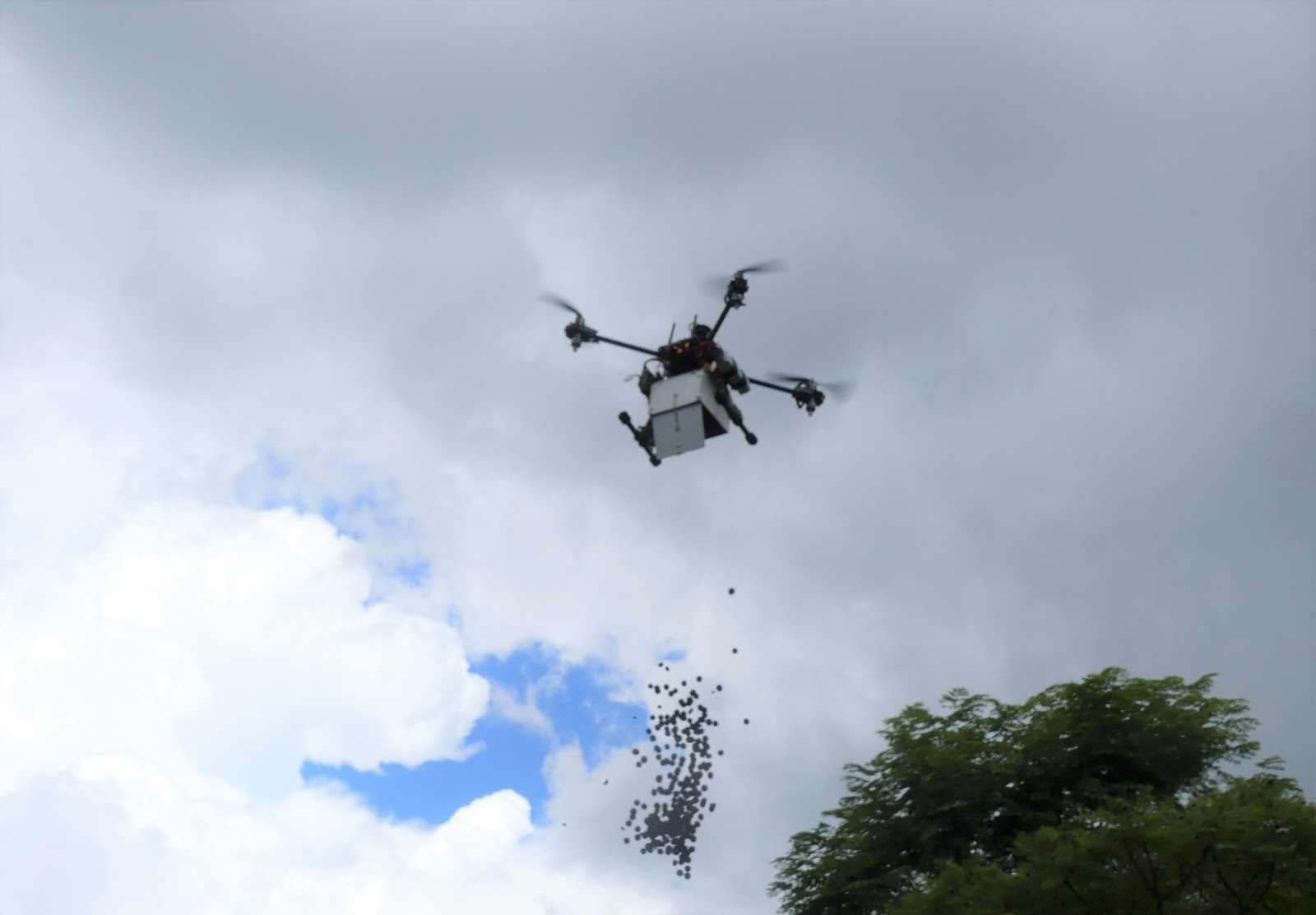
 Other Aerial Seeding Platforms


Crop Spraying Aircraft. 
This is the best way to do this on scale at short notice - the only company in Kenya, Farmland Aviation, who can currently do this on a large industrial scale can be found here. https://www.youtube.com/watch?v=kOWM_7kXWpg  - they can spread up to 2 tons of seedballs per hour over tens of thousands of acres.


Aerial seeding trial in the Mau Narok Forest - https://youtu.be/yG0toHGNJhY?t=20


Unmanned Aerial Vehicles

Current day low-cost UAV's that are available to the general public lack of payload capacity and range which limits them for most aerial seeding applications. Currently they seem to be best applied for use in mapping and monitoring forests.


There are a few new companies who are expanding this technology rapidly:


Paragliding:
Quite possible one of the best methods we have seen so far of adding tree seed distribution to existing flight plans would definitely have to be at Borana Kenya, they sometimes throw out seeds as they take tourists on some of the most interesting adventure safari's in Kenya.

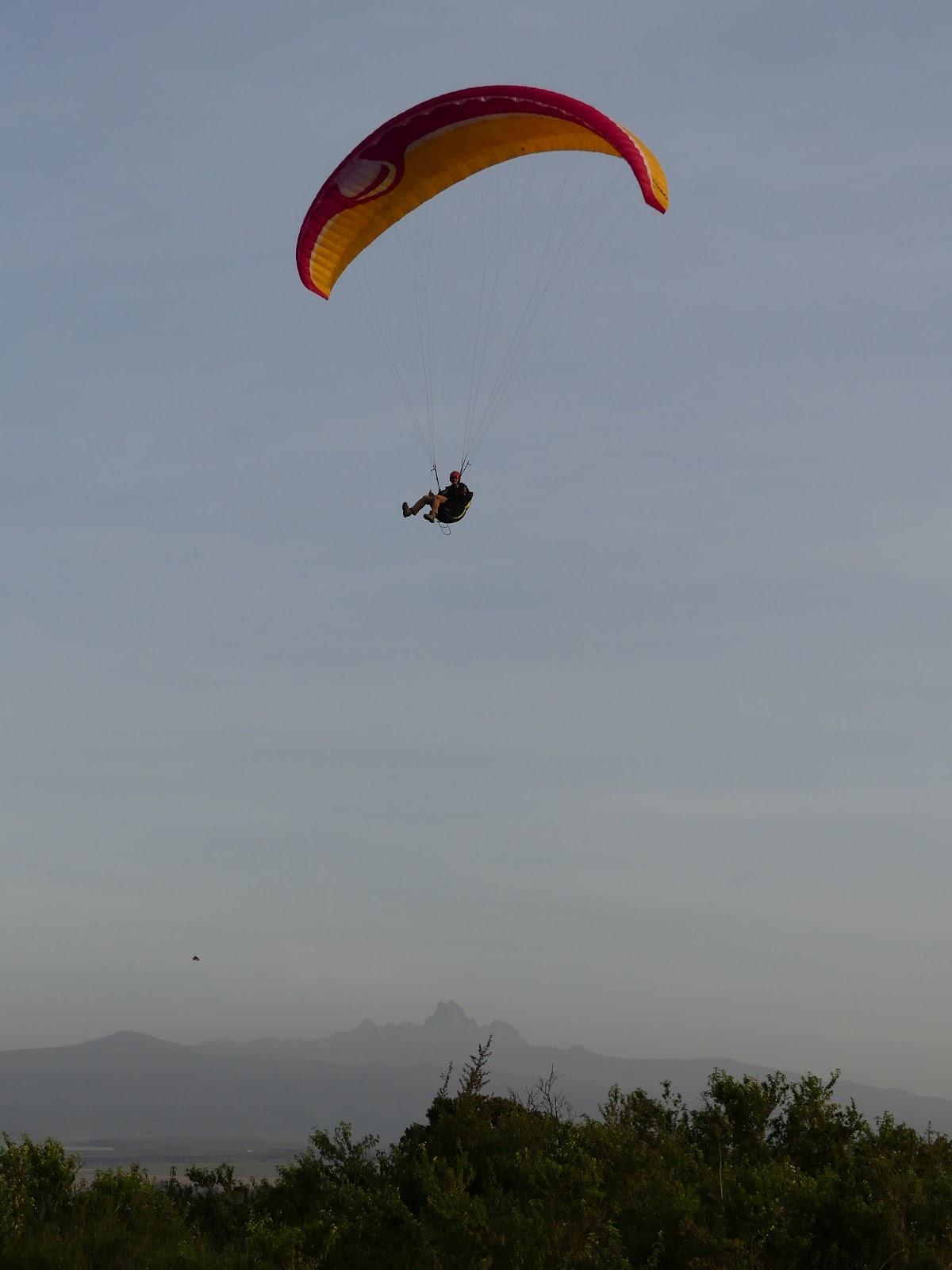


On the first proof of concept flight were able to carry about 2kgs (1,000+ acacia seedballs) on this first tandem trial. 


The Sky is the Limit for Tree Planting! 


Hot Air Balloons
A shrinking riverine forest is given a boost with SeedBalls from Musiara balloons. Daily.
Photo credit Alisa Bowen


For more information please see www.seedballskenya.com or email us on seedballskenya@gmail.com


Aerial tree seeding for landscape forest restoration in East Africa.

 Recommendations and Research Needs


Preface: After 5 or so years of reading about aerial tree seeding and it's potential for low cost landscape scale reafforestation of degraded woodlands and forests, we have started this blog to aggregate as much information about this as we can for use by forestry industry professionals and enthusiasts in East Africa. 


First Kenyan trials of dryland aerial tree seeding Timau - 2016


Aerial tree and pasture seeding presents many challenges and opportunities, especially in Tropical countries. While technology and techniques are developed and available, they are yet to be tested and adapted for use in Tropical areas now suffering devastating deforestation. Because experience with aerial seeding of forests in humid and dry land tropics is limited, little is known about the methodologies for achieving meaningfull seeding success rates.
We are focusing on the more desirable endemic timber, fuelwood, charcoal,  fodder and pioneer species growing naturally in their area,  that are currently being over harvested such as the acacia species.
Initially, these trials have not required the use of aircraft. It is necessary only to broadcast a small amount of seed (pelletized vs. controls) on a small patch of the area being tested with conventional tree-planting methods. However, to evaluate fully the potential of aerial seeding in a given area, we must consider:

· The characteristics of species, especially the ability of its seed to germinate.

· The choice of site and site preparation;

· Effect of season and weather on best time for sowing;

· Seed acquisition;

· Seed handling (storage, transport, care in the field);

. Seed preparation (stratification, coating with animal repellents, inoculation, testing the

coatings for toxicity to seeds or seedlings); and

· Major predators.

Biochar seedballs - a Chardust Ltd. - Cookswell Jikos collaboration! Www.seedballskenya.com

Appx 40% germination of acacia xanthophloea at 12 days. 

Existing plantations and natural stands can sometimes demonstrate how successful direct seeding is likely to be. They indicate the best season to sow the seeds and can generally foretell the seed predation and the success of natural germination (care must be taken that the natural germination being observed is occurring in conditions that approximate those on sites to be sown). The silvics ( the study of the life history and characteristics of forest tree) of the species in question should be studied to determine its suitability for direct seeding.

Direct-seeding trials should first be implemented at sites favorable for seeding, and then, with experience, should move to the more difficult sites.
Along with all direct-seeding trials should be some seedling-planting trials. The relative costs and successes of the two techniques can be better judged when they are done in tandem.

Before aerial seeding, sites should be chosen and inspected, if possible, at least 8 months in advance. Factors to be considered include:

. Extent of grazing by livestock and wildlife;

· Infestations of ants, rodents, and seed-eating birds;

· Areas where trees are adequately reproducing naturally;

· Conditions of seedbed and need for burning the site; and

· Advantageous ridges from which aircraft can be guided.


With this information plans can be made for site preparation, seed procurement, and any seed coatings.

Researchers wishing to improve the technology and techniques of aerial seeding might pursue the following challenging research projects:

. Aerial reforestation of regions covered with local forbs and other vigorous tropical grass species;

· Development of seed coatings for use in dry sites that absorb and hold water and yet do not disintegrate rapidly;

· Improvement of seeding equipment to provide greater control over seedling density and spacing;

. Development of less hazardous chemicals for protecting seeds from rodents, insects, and birds (some examples worth considering are wood vinegar, neem oil, chillies, clay, copper sulfate.) 

. Development of seed coatings containing spores of mycorrhizal fungi.


The existing knowledge on seed coating and pelleting should be reviewed. Successes and failures are reported in different situations.

Seed can be targeted accurately (often within a meter or two). Thus aerial seeding might prove feasible for filling in the widely scattered breaks in the forest left by slash-and-burn farmers or charcoal makers with useful species that best protect the vulnerable soil.

Examples of degraded and erosion prone areas in Southern Kenya that could potentially use aerial seeding.


Here are some links to information about seed coatings and aerial seeding;

http://www.seedballskenya.com/seedballs/4593024001

http://www.futureterrains.org/robots-revive-rainforests-guest-blog-stephen-elliott-forru-thailand/

Germination trials of the biochar acacia tree seedballs


Some historical clips of post-war aerial seeding after WWII.


Examples of aerial seeding trials from around the world.


Rare shots of UH-1B helicopters of Vietnam People Air Force in the aerial seeding configuration.
Following the conclusion of the Vietnam War, the Air Force devoted many of its American-made assets to improve agriculture production across the country.'
https://twitter.com/AnnQuann/status/1267388611067953153


Alternative seed distribution methods are also under R&D in Kenya :) 


Here is a short video of one of our most recent tests.


Thanks for reading and please dont hesitate to contact us at seedballskenya@gmail.com for more information. 


tree seeding kenya

After all - hundreds of species trees have spent millions of years perfecting aerial tree seeding - with a bit of help, perhaps with technology and information transfer, we can find a way to make planting and growing billions of trees more cost effective! 


Monday, July 28, 2014

Equipment and Costs for aerial tree seeding.

Equipment needed for aerial forest restoration. 


Aerial seeding can done by fixed-wing aircraft or helicopters, autonomous aerial vehicles or  paragliders, hot air ballons etc, usually flying at 15-200m altitude.


Airplanes already in use in pest control or aerial surveying can easily be adapted for use in aerial seeding by slightly modifying the hopper gate to control the flow of seed into the seed-distributing device. Further, they can be used in association with their normal agricultural program, provided they can be utilized at short notice when the conditions for aerial seeding become suitable. Such aircraft are highly maneuverable and can operate from simple, improvised airstrips such as logging roads. Appropriate types are already available in most, perhaps all, developing countries (for a detailed study of the use of aircraft in agriculture see Akesson and Yates, 1974).

For over 20 years in the southern United States, helicopters have been employed to seed forests. Generally, they are more maneuverable than fixed wing aircraft and give better placement of seed; for example, along the edges and in the corners of irregular tracts of land, on steep mountainsides, and in areas as small as 0.5 hectares. Moreover, helicopters can land on site and reload more quickly than fixed-wing planes and the helicopter pilot can check results and discuss plans more readily with ground staff.


Autonomous and Unmanned Aerial Seeding 


Weeding would be essential to maximize survival of aerially seeded trees. But drones could help with that too. How about a drone which uses plant recognition technology to spray a systemic, non-residual herbicide on grass and other weeds, but avoids spraying young trees? So called “smart spraying” is already used in horticulture.
And lastly there’s monitoring. Drones are already being used to photograph field sites. Image analysis techniques could easily be developed to track changes in the ratio of tree crown cover to weeds, thus making it possible to plot progress towards the first milestone of any forest restoration project i.e. canopy closure.


Drones could recharge their batteries on-site using electromagnetic induction pads connected to solar charged batteries, raising the intriguing possibility of the whole restoration process ultimately becoming automated.
A few years ago, all this was regarded as science fiction, more appropriate for the plot of a Star Trek movie plot than for serious consideration. But not anymore. Most of these technologies already exist … we just have to improve them and combine them in innovative ways to achieve the desired results.

So it’s time for a serious discussion. Otherwise, pledges to restore hundreds of millions of hectares of forest become just a pipe dream.''  Link to Changi Mai Universities Autonomus forestry program here >  http://www.futureterrains.org/robots-revive-rainforests-guest-blog-stephen-elliott-forru-thailand/


But by far one of the most carbon neutral and quiet ways of doing this is paragliding! 

It is as free as the air and probably the most beautiful method of aerial seeding that we highly hope to investigate more of!


A quick 45min flight can disperse 1000's of  tree seedballs! 


For larger projects - seed containers (hoppers) and distributors that attach to aircraft are commercially available, wel1 developed, and reliable. Most commercially available seeding devices have power-driven augurs to control the rate of seed flow and either venturi or powered slinger-type applicators for spreading the seed (fixed-wing aircraft usually use gravity flow of seed and an unpowered venturi-type distributor. Helicopters must use a power-driven slinger because their speed is inadequate for venturi action). Most units are also capable of sowing seeds in a range of sizes. At normal altitudes and flying speeds the distributors on fixed-wing aircraft throw seed over a swath about 20 m wide. The power slingers attached to helicopters throw seed over a swath about 30 m wide. In good weather an aircraft in the United States routinely sows 1,200-1,500 hectares daily. Under favorable conditions (e.g., with landing sites close by) as much as 3,000 hectares have been seeded in a day.

See http://www.helispread.com for detail

Ideally, before aerially seeding 10 hectares or more, the prospective site is delineated on the ground and the pilot is provided with maps or aerial photos. Arrangements are made for radio communication between the aircraft and ground crew (although desirable, this is not essential). A system for measuring the seed distribution on the site is worked out in advance and, if possible, flagrnen are positioned to guide the aircraft so as to avoid overlapping runs (techniques newly developed in the United States include the use of aluminum flags (dropped from the plane) as well as electronic field triangulation, both of which guide the planes without using flagmen).

Pest Control and Pelletizing (Seedballs)

Charcoal Dust coated acacia tree seedballs.

The major problem in aerial seeding is not one of engineering or plant science per se; it is the problem of seed predators. Almost any small animal (bird, insect, mouse, shrew, chipmunk, squirrel) will eat or remove seeds lying on the soil surface. It is essential to know the composition and population of seed-eating animals before aerially seeding an area. Mice and birds are generally the most destructive.

Normally, the seeds must be coated with chemicals to repel those animals most likely to eat them. Further, seeds should be sown, if possible, at a season when pest populations are low. Site preparation (i.e., burning or scarification mentioned above) not only prepares a good seedbed, but it often reduces predator populations. The likelihood of different predators stealing the seeds can be easily assessed by covering tiny sample areas with cages whose mesh sizes are selected to keep out different predators (mice, rats, birds, and ants, for example).

To avoid predation, the seed must be made to germinate as quickly as possible. Seed of some species, especially those with hard seed coats, must be stratified (subjected to moisture at low temperature to break dormancy) or scarified (treated with acid, hot or cold water, or mechanical abrasion) to increase seed-coat permeability and ensure rapid germination.


Natural predator repellent


"Often up to 80% of broadcast seed is lost to birds, mice and insects before it can germinate. In one field test I conducted on western range land, harvester ants alone collected a quarter pound of grass and wildflower seeds, from one square yard, in less than an hour! To work well seed balls need to be used in areas that receive at least 10 to 12 inches of annual precipitation, but the timing of the rains is also important. Three to five inches of rain are required to dissolve the seed balls and begin germination. Continued rains are then needed to promote growth and establish viable root systems
.
Light rains may only soften the clay and allow predators like birds, mice and ants to tear the seed balls apart and even dig under them for seeds. So it may be necessary to add a natural repellent such as red chili pepper, catnip, pennyroyal or peppermint, to the seed balls to prevent predation. The amount of repellent added will vary with the type, but about 10% by volume of the amount of soil compost should be sufficient.
Dried, powdered chili peppers appear to provide substantial protection across a broad range of predators for the least amount of material used.  If you use red chili, wear gloves and a mask to avoid irritation. You may also need to experiment to find the most effective repellents for your local predators." in, Seedballs and predators, the use of natural repellents, by Jim Bones (seedballs.com). Trevis (1958), found a colony of Veromessor pergandei (Mayr) collected an average of 7,000 seeds a day in the Sonoran Desert, Colorado, U.S.A., and calculated that six colonies would collect 15 million seeds from one acre in one year... thats a lot of seeds.


Fungi

Beneficial plant-microbe interactions in the rhizosphere are primary determinants of plant health and soil fertility. Arbuscular mycorrhizae are the most important  symbionts for the majority of plants and, often influence plant community development, nutrient uptake, water relations and above-ground productivity. They also act as bioprotectants against pathogens and toxic stresses. Arbuscular mycorrhizal fungi (AMF) have an impact in landscape regeneration, horticulture, alleviation of desertification and in the bioremediation of contaminated soils.
You can also try collect soil from the area you plan on seeding to innoculate your seedballs.


Many thanks to all who have been involved and have offered so much helpful advice to get the planning works underway. Watch this space for updates on this experimental forestry project.