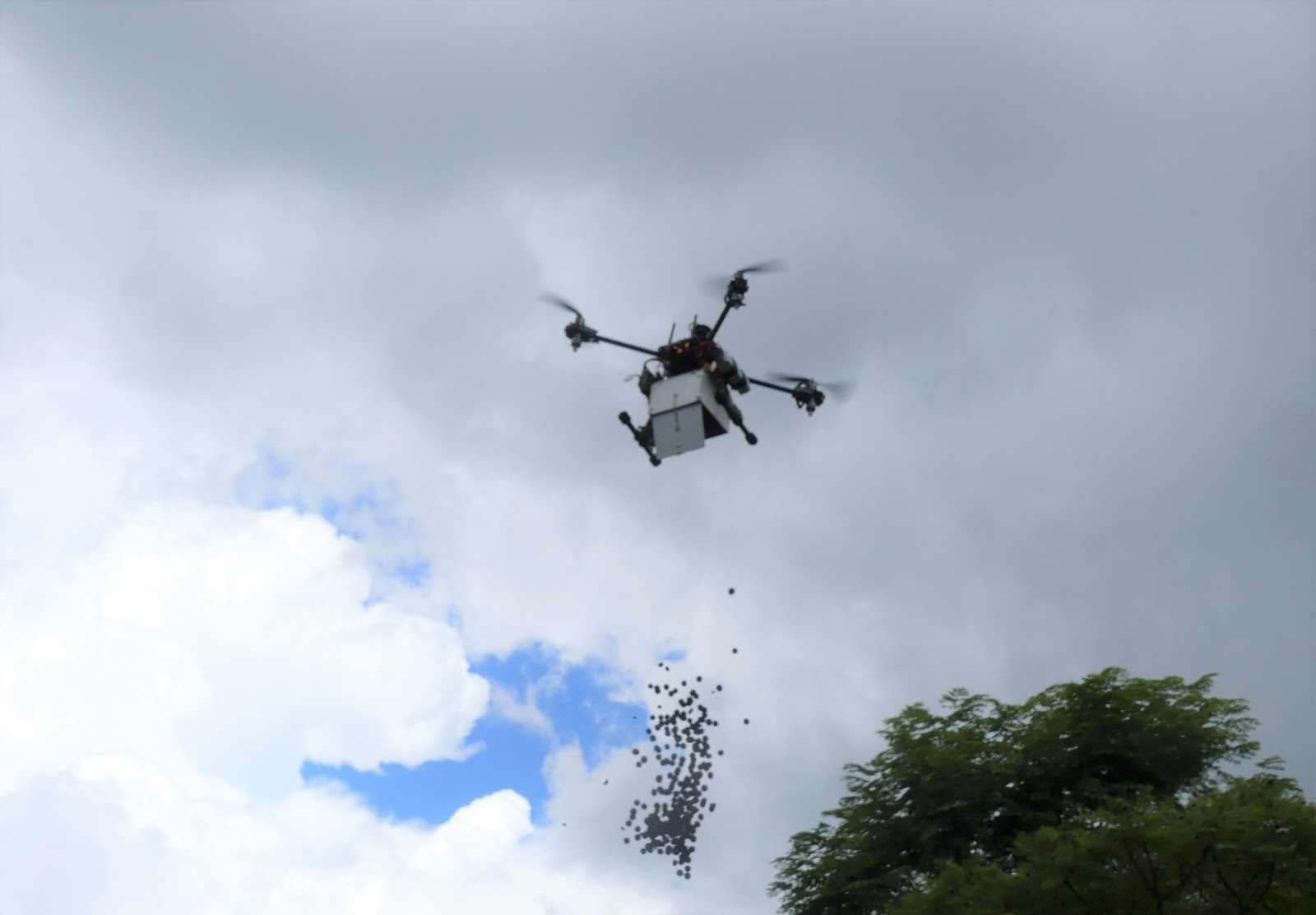
For larger projects - seed containers (hoppers) and distributors that attach to aircraft are commercially available, wel1 developed, and reliable. Most commercially available seeding devices have power-driven augurs to control the rate of seed flow and either venturi or powered slinger-type applicators for spreading the seed (fixed-wing aircraft usually use gravity flow of seed and an unpowered venturi-type distributor. Helicopters must use a power-driven slinger because their speed is inadequate for venturi action). Most units are also capable of sowing seeds in a range of sizes. At normal altitudes and flying speeds the distributors on fixed-wing aircraft throw seed over a swath about 20 m wide. The power slingers attached to helicopters throw seed over a swath about 30 m wide. In good weather an aircraft in the United States routinely sows 1,200-1,500 hectares daily. Under favorable conditions (e.g., with landing sites close by) as much as 3,000 hectares have been seeded in a day.
See http://www.helispread.com for detail
Ideally, before aerially seeding 10 hectares or more, the prospective site is delineated on the ground and the pilot is provided with maps or aerial photos. Arrangements are made for radio communication between the aircraft and ground crew (although desirable, this is not essential). A system for measuring the seed distribution on the site is worked out in advance and, if possible, flagrnen are positioned to guide the aircraft so as to avoid overlapping runs (techniques newly developed in the United States include the use of aluminum flags (dropped from the plane) as well as electronic field triangulation, both of which guide the planes without using flagmen).
Pest Control and Pelletizing (Seedballs)
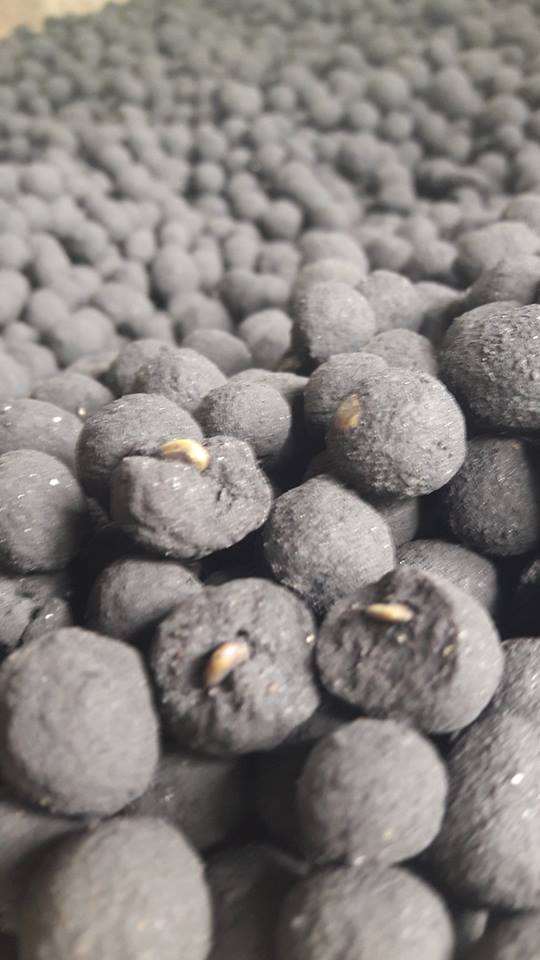
Charcoal Dust coated acacia tree seedballs.
The major problem in aerial seeding is not one of engineering or plant science per se; it is the problem of seed predators. Almost any small animal (bird, insect, mouse, shrew, chipmunk, squirrel) will eat or remove seeds lying on the soil surface. It is essential to know the composition and population of seed-eating animals before aerially seeding an area. Mice and birds are generally the most destructive.
Normally, the seeds must be coated with chemicals to repel those animals most likely to eat them. Further, seeds should be sown, if possible, at a season when pest populations are low. Site preparation (i.e., burning or scarification mentioned above) not only prepares a good seedbed, but it often reduces predator populations. The likelihood of different predators stealing the seeds can be easily assessed by covering tiny sample areas with cages whose mesh sizes are selected to keep out different predators (mice, rats, birds, and ants, for example).
To avoid predation, the seed must be made to germinate as quickly as possible. Seed of some species, especially those with hard seed coats, must be stratified (subjected to moisture at low temperature to break dormancy) or scarified (treated with acid, hot or cold water, or mechanical abrasion) to increase seed-coat permeability and ensure rapid germination.
Natural predator repellent
"Often up to 80% of broadcast seed is lost to birds, mice and insects before it can germinate. In one field test I conducted on western range land, harvester ants alone collected a quarter pound of grass and wildflower seeds, from one square yard, in less than an hour! To work well seed balls need to be used in areas that receive at least 10 to 12 inches of annual precipitation, but the timing of the rains is also important. Three to five inches of rain are required to dissolve the seed balls and begin germination. Continued rains are then needed to promote growth and establish viable root systems
.
Light rains may only soften the clay and allow predators like birds, mice and ants to tear the seed balls apart and even dig under them for seeds. So it may be necessary to add a natural repellent such as red chili pepper, catnip, pennyroyal or peppermint, to the seed balls to prevent predation. The amount of repellent added will vary with the type, but about 10% by volume of the amount of soil compost should be sufficient.
Dried, powdered chili peppers appear to provide substantial protection across a broad range of predators for the least amount of material used. If you use red chili, wear gloves and a mask to avoid irritation. You may also need to experiment to find the most effective repellents for your local predators." in, Seedballs and predators, the use of natural repellents, by Jim Bones (seedballs.com). Trevis (1958), found a colony of Veromessor pergandei (Mayr) collected an average of 7,000 seeds a day in the Sonoran Desert, Colorado, U.S.A., and calculated that six colonies would collect 15 million seeds from one acre in one year... thats a lot of seeds.
Fungi
Beneficial plant-microbe interactions in the rhizosphere are primary determinants of plant health and soil fertility. Arbuscular mycorrhizae are the most important symbionts for the majority of plants and, often influence plant community development, nutrient uptake, water relations and above-ground productivity. They also act as bioprotectants against pathogens and toxic stresses. Arbuscular mycorrhizal fungi (AMF) have an impact in landscape regeneration, horticulture, alleviation of desertification and in the bioremediation of contaminated soils.
You can also try collect soil from the area you plan on seeding to innoculate your seedballs.
Many thanks to all who have been involved and have offered so much helpful advice to get the planning works underway. Watch this space for updates on this experimental forestry project. |