Showing posts with label aerial seeding. Show all posts

Tuesday, April 7, 2020

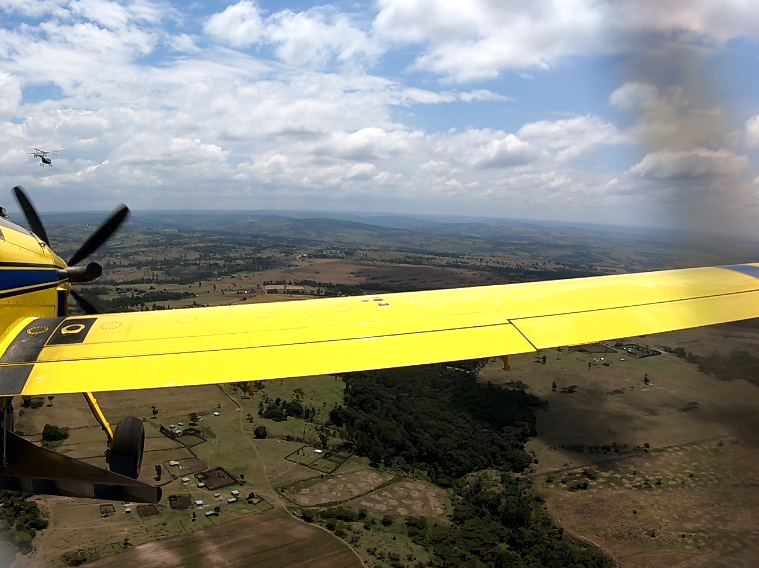
Piggybacking tree seed distribution onto aerial patrols.


Illegal charcoal making and its after effects pose a huge challenge to the biodiversity health of dryland areas all over Kenya. Old growth (generally acacia) trees are cut for their high quality wood that is made into charcoal for the cooking needs of Kenya's rapidly growing urban populations. Sadly this not only removes key tree species from landscapes, it also burns the land where the charcoal was made and depletes natural seedbanks.(https://kenyacharcoal.blogspot.com/2019/12/rehabilitation-of-traditional-charcoal.html)

But thanks to our amazing ReGreen Kenya partners like the Mara Elephant Project, who can piggyback seedball distribution into their day to day patrol work, we can at least help to get the right species of indigenous tree and grass seeds into the right degraded areas to help start reversing some of this long term damage right away.


Prior understanding of eco-system and selective logging types to match species per location is key.


Calculations for how many seeds (or seedballs) can be distributed should be planned well in advance by the Pilot and collecting GPS points on distribution locations for future follow ups is highly advised.


If you would like to help and send them or any of our other partners a big bag of seedballs to plant on your behalf in areas like these - please see here; http://www.seedballskenya.com/donate/4594311653


Sunday, October 6, 2019

Spreader Setup for Aerial Application

Spreaders are attached to agricultural aircraft and used to distribute seeds, fertilizers and dry chemical products. The first time an airplane was used to treat crops was in 1921 when a U.S. Army pilot applied insecticide to Ohio’s catalpa trees infested with moth. Since then, agricultural aviation has proven to be a fast and efficient form of product application to our crops.


The most common spreader used in agricultural aviation in the United States is the venturi or RAM spreader. Venturi spreaders clamp to the gate box at the base of the aircraft’s hopper. The gate boxes are 25, 38 or 41 inches wide depending on the size of the aircraft. As the adjustable door (gate) on the gate box opens, material from the hopper falls into the venturi spreader, and it is distributed by the airflow through the spreader. The opening of the door determines the flow rate. Some of the limitations on venturi spreaders include high aerodynamic drag, high power requirements and low quality pattern of distribution for high application rates (greater than 250 pounds per acre).


The venturi spreader is composed of ducts, also called vanes that can vary in number from five to 13. Each vane has adjustable sections at the front or rear. Adjustments on the front portion of the vane modifies the amount of material and air that moves through it. Adjustments of the rear section of the vanes may change the initial path of the material leaving the spreader.


 As an aerial applicator your job is to deliver product (fertilizer, seeds, etc.) on time, with great quality and precision. Major concerns to applicators are swath width, uniformity and operation efficiency. How the spreader is mounted (attitude), the rate of application and variations in the material’s physical properties have major effects on swath width and uniformity of application. Larger swath widths will increase operation efficiency (acres per hour), a “must-do” today with the increasing operational costs.


Variable-rate application (VRA) is a technique often used by progressive farmers in which different product rates are applied in the field in an attempt to match varying field requirements according to features such as soil type or field topography. Farmers and agricultural consultants work together to develop variable-rate maps. Computerized systems for variable-rate application of dry material are available for agricultural airplanes.


These systems automatically adjust gate opening during flight, releasing more or less material according to a prescription map, ground coordinates and aircraft speed. The system also can be used to adjust material release based on aircraft ground speed, offering a precise single-rate application. VRA may be a great option for farmers wishing to apply precision-farming technology to their fields, and it may offer aerial applicators the opportunity to add value to their services, therefore enhancing their level of customer service.


With credit to https://aerialspray.co.za/ewExternalFiles/pub3078SpreaderSetupforAerialLOWRES.pdf  and Farmland Aviation Kenya.

Monday, May 6, 2019

Before and after photos of a few direct seeding sites around Kenya using indigenous grass and tree seedballs

2017 and 2019 World Vision DryDev Test Plot Matuu, Machakos. 

2016 and 2018 DSWT rehabilitation of SGR quarry, Voi, Taita County. 

2018 - 2019 DTB seeding project Aitong, Maasai Mara

2018 - 2019 DTB seeding project Aitong, Maasai Mara


Learn more at www.seedballskenya.com

Sunday, June 19, 2016

Aerial tree seed collection

Helicopter seed collection from natural stands has been going on since the 1970s using cone harvesters. 


Suggestions for faster collections

 Cone collecting is fastest where trees have fairly narrow crowns, tops have a heavy cone crop, cones are of good quality, cones are not opening (so every tree can be picked), and most trees in a patch have good crops. The biggest hindrance to a good cone yield is cones that are turning brown and therefore unusable.

 -A good pilot experienced with external load flying is the key to getting cones to the ground quickly.

 -Before starting a collection, locate key stands of heavy cone crop, check seed counts, determine the maturity of the cones and find suitable unloading and refuelling sites. This preplanning results in a smoother operation and higher production per hour. !

-Select unloading sites below the stand being raked because flying upward with the basket empty is easier than with it full.

-Whenever possible, transport a rake to the collecting site by truck or trailer. Aerial ferrying of rakes reduces helicopter airspeed to about 80-90 mph (130-145 km/h).

-Fly paths that minimize distances between trees. Generally, fly out empty and rake trees on the way back so that the longest flight is with an empty basket.

-A ground crew of two is best but one person can clean a rake.

-Self-dumping rakes can dump tops directly into trucks or trailers for transport to better sacking sites.

Generally, dumping sites should be less than two kilometres from trees, although the species and abundance of cones influence the cost/benefit ratio. The supply of Fandrich aerial rakes has never been a problem. Even during the heavy cone crop year of 1993 when all 49 Fandrich cone rakes were working, every request for a machine was met on time. Reserving a rake is part of a good collection plan. Availability of helicopters can be a problem, though. During hot dry summers helicopter companies may need to give priority to fighting forest fires and may not have a machine available for picking cones.


Material and information from http://www.coneharvesters.com/ please contact them for more information.


And for autonomous aerial tree seed collection  the Chang Mai University in Thailand is working on this > 


 Youtube video link to their amazing work here