Aerial application of 300kgs of mixed indigenous acacia tree seedballs on an area that was illegally degraded by charcoal makers who mostly targeted mature acacia trees near Aitong, Narok South, Kenya.
But effective for biodiversity enrichment programs where straight lines and an even spread is unwanted.
Selective seeding of high density woodfuel extraction areas in-between the new farms/pastures. .
Read more about the scorched earth result from charcoal kilns.
May 2019
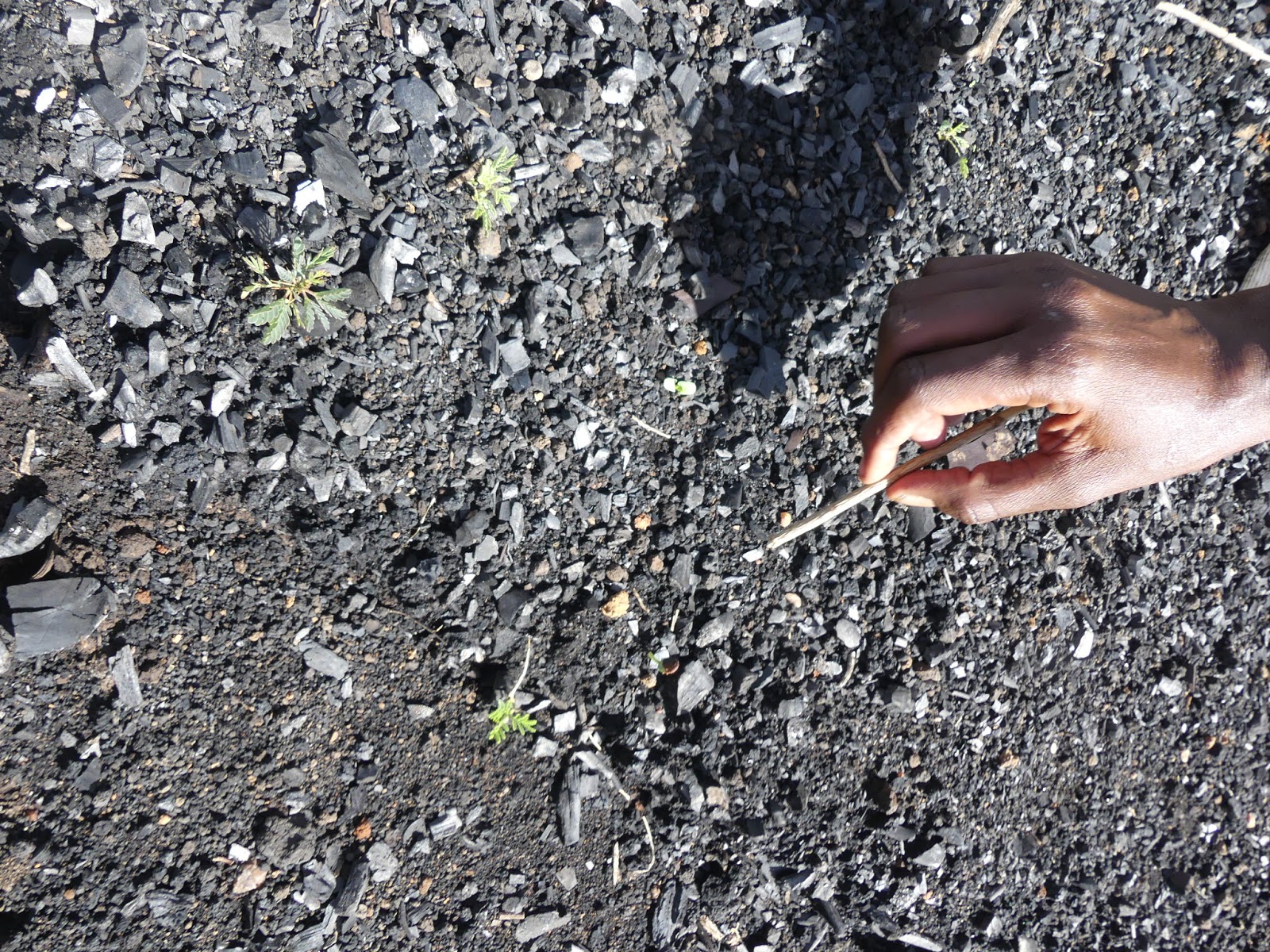
This one at 5 months of age and having defied the goats and dikdiks now faces increased elephant pressure and an uncertain climate future. But like most acacia trees...its tough enough not to worry to much ;)
The local landowner showing us some of the thousands of sprouts on the many charcoal kiln sites.
Differential germination rates from natural seed dormancy help spread regeneration over a few years with the acacia species.
Lack of any other sprouts of any forbs or grasses shows a semi-sterile seedbed.
Preface: After 5 or so years of reading about aerial tree seeding and it's potential for low cost landscape scale reafforestation of degraded woodlands and forests, we have started this blog to aggregate as much information about this as we can for use by forestry industry professionals and enthusiasts in East Africa.
First Kenyan trials of dryland aerial tree seeding Timau - 2016
Aerial tree and pasture seeding presents many challenges and opportunities,
especially in Tropical countries. While technology and techniques are developed
and available, they are yet to be tested and adapted for use in Tropical areas
now suffering devastating deforestation. Because experience with aerial seeding
of forests in humid and dry land tropics is limited, little is known about the
methodologies for achieving meaningfull seeding success rates.
We are focusing on the more desirable endemic timber,
fuelwood, charcoal, fodder and pioneer species growing naturally in their area, that are currently being over harvested such
as the acacia species.
Initially, these trials have not required the use of
aircraft. It is necessary only to broadcast a small amount of seed (pelletized vs.
controls) on a small patch of the area being tested with conventional
tree-planting methods. However, to evaluate fully the potential of aerial
seeding in a given area, we must consider:
· The characteristics of species, especially the ability of its seed to germinate.
· The choice of site and site preparation;
· Effect of season and weather on best time for sowing;
· Seed acquisition;
· Seed handling (storage, transport, care in the field);
. Seed preparation (stratification, coating with animal repellents, inoculation, testing the
Appx 40% germination of acacia xanthophloea at 12 days.
Existing plantations and natural stands can sometimes demonstrate how successful direct seeding is likely to be. They indicate the best season to sow the seeds and can generally foretell the seed predation and the success of natural germination (care must be taken that the natural germination being observed is occurring in conditions that approximate those on sites to be sown). The silvics ( the study of the life history and characteristics of forest tree) of the species in question should be studied to determine its suitability for direct seeding.
Direct-seeding trials should first be implemented at sites favorable for seeding, and then, with experience, should move to the more difficult sites. Along with all direct-seeding trials should be some seedling-planting trials. The relative costs and successes of the two techniques can be better judged when they are done in tandem.
Before aerial seeding, sites should be chosen and inspected, if possible, at least 8 months in advance. Factors to be considered include: . Extent of grazing by livestock and wildlife; · Infestations of ants, rodents, and seed-eating birds; · Areas where trees are adequately reproducing naturally; · Conditions of seedbed and need for burning the site; and · Advantageous ridges from which aircraft can be guided.
With this information plans can be made for site preparation, seed procurement, and any seed coatings.
Researchers wishing to improve the technology and techniques of aerial seeding might pursue the following challenging research projects: . Aerial reforestation of regions covered with local forbs and other vigorous tropical grass species; · Development of seed coatings for use in dry sites that absorb and hold water and yet do not disintegrate rapidly; · Improvement of seeding equipment to provide greater control over seedling density and spacing; . Development of less hazardous chemicals for protecting seeds from rodents, insects, and birds (some examples worth considering are wood vinegar, neem oil, chillies, clay, copper sulfate.) . Development of seed coatings containing spores of mycorrhizal fungi.
The existing knowledge on seed coating and pelleting should be reviewed. Successes and failures are reported in different situations.
Seed can be targeted accurately (often within a meter or two). Thus aerial seeding might prove feasible for filling in the widely scattered breaks in the forest left by slash-and-burn farmers or charcoal makers with useful species that best protect the vulnerable soil.
Examples of degraded and erosion prone areas in Southern Kenya that could potentially use aerial seeding.
Here are some links to information about seed coatings and aerial seeding;
Germination trials of the biochar acacia tree seedballs
Some historical clips of post-war aerial seeding after WWII.
Examples of aerial seeding trials from around the world.
Rare shots of UH-1B helicopters of Vietnam People Air Force in the aerial seeding configuration.
Following the conclusion of the Vietnam War, the Air Force devoted many of its American-made assets to improve agriculture production across the country.'
Thanks for reading and please dont hesitate to contact us at seedballskenya@gmail.com for more information.
After all - hundreds of species trees have spent millions of years perfecting aerial tree seeding - with a bit of help, perhaps with technology and information transfer, we can find a way to make planting and growing billions of trees more cost effective!